
Lincolnwood Lawn Care, Fertilizing & Weed Control
The grass really is Greener the way we treat it.
The grass really is Greener the way we treat it.
Lincolnwood is a compact, well-established village of roughly 13,000 residents in Cook County, nestled directly north of Chicago's city limits and just south of Skokie. Spanning only about two and a half square miles centered on the 60712 ZIP code, Lincolnwood packs a distinctly residential character into a small footprint. Most homes were built during the 1950s and 1960s suburban building boom — classic brick ranches, split-levels, and bi-levels line the streets between Touhy Avenue on the south, Devon Avenue on the southeast, and Pratt Boulevard on the north. The lots are modest by suburban standards — typically 50-by-125-foot parcels — but Lincolnwood homeowners take tremendous pride in their lawns. That pride shows on every block. Our 7-round fertilizing and weed control program is built for Lincolnwood's conditions: heavy Cook County clay soil, compact lots with a mix of sun and shade from 60-plus-year-old trees, and homeowners who expect a consistently green, weed-free lawn from spring through fall. We push-spread every application on foot — no heavy ride-on equipment damaging your already-dense clay. Every treatment is guaranteed: if weeds appear between visits, retreatment is free.
Seven treatments from early spring through late November. We begin with a crabgrass preventer and granular starter feed in early April as Lincolnwood soils warm past 50 degrees. Spring broadleaf sprays target dandelions, clover, and Creeping Charlie as they emerge — we adjust our approach for each property since a sunny front yard on Kostner Avenue receives different treatment than a shaded backyard on Hamlin near the tree-lined blocks. Summer rounds use lighter, slow-release nitrogen to sustain color without promoting heat stress or disease. Fall rounds increase nitrogen to thicken the stand and naturally crowd out weeds the following spring. The final late-November winterizer deposits nutrients deep into the root zone for winter storage. Every visit includes a detailed door note explaining what was applied and why. Retreatments between scheduled rounds are always included at no extra charge.
We provide comprehensive lawn and landscape services throughout Lincolnwood and surrounding communities. Click any service below to learn more:
Request your free lawn estimate below — we respond within hours.
Locally owned and operated in Chicagoland
Fully certified in the state of Illinois
Free re-treatments between scheduled visits
Serving Lincolnwood and all of Chicagoland, we have built our reputation on honest service, guaranteed results, and treating every lawn like our own. Our 7-round program is designed specifically for Illinois growing conditions — heavy clay soils, harsh winters, and hot summers.
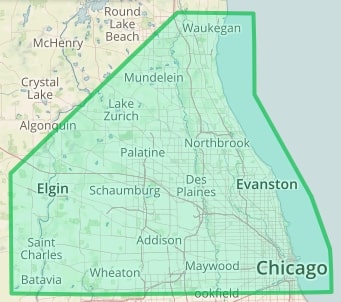
Greener Living Lawn Care delivers expert lawn fertilizing and weed control in Lincolnwood, Illinois (Cook County, ZIP 60712). Lincolnwood is a small, densely residential village immediately north of Chicago — bordered by Devon Avenue to the southeast, Touhy Avenue to the south, and Skokie to the north and west. The Edens Expressway (I-94) runs along the village's eastern edge, and Lincoln Avenue bisects the community diagonally, serving as the primary commercial corridor with restaurants, shops, and the Lincolnwood Town Center development area. Despite its proximity to Chicago, Lincolnwood has a distinctly suburban feel — tree-lined streets, quiet residential blocks, and a strong sense of neighborhood identity. Most homes date from the mid-20th century building boom, giving the village a unified architectural character. The lots are modest in size, typically 50 by 125 feet, but homeowners here maintain some of the neatest front lawns in Cook County.
Lincolnwood's lawn care challenges are typical of inner-ring Cook County suburbs. Sixty-plus years of foot traffic, mowing, and freeze-thaw cycles have compacted the heavy clay soils. This compaction restricts root growth, slows drainage, and creates thin, stressed turf that weeds exploit readily. Crabgrass is the primary summer invader — it colonizes sunny edges along driveways, sidewalks, and parking pads where soil temperatures are highest. Creeping Charlie and Wild Violets dominate shaded backyards beneath mature silver maples, ashes, and oaks. Dandelions and clover fill any remaining gaps. Our program addresses each of these issues systematically across seven rounds. We time our crabgrass preventer for Lincolnwood's specific microclimate — not a generic Chicagoland calendar — and we use Momentum herbicide for stubborn ground ivy and violets that shrug off standard broadleaf sprays.
Weed pressure in Lincolnwood is relentless because the conditions favor them: compacted clay, partial shade, and mature landscapes that thin naturally over time. Our approach is multi-layered. Pre-emergent crabgrass control goes down each spring before soil temperatures reach germination threshold. Post-emergent broadleaf sprays target dandelions, clover, and plantain as they appear through spring and fall. For Creeping Charlie — which is endemic in Lincolnwood's shaded backyards — we use Momentum herbicide, a specialized formulation that penetrates the waxy leaf coating that generic broadleaf sprays cannot. Wild Violets receive the same treatment. Thistle, spurge, and oxalis are controlled on contact during our scheduled visits. If any weeds reappear between rounds, retreatment is always free. For properties with severe Creeping Charlie infestations — common in blocks where large trees create nearly full canopy — we plan a multi-season elimination strategy, because honest results take time.
If there is one service that makes the biggest single-season difference on Lincolnwood lawns, it is core aeration. After 60-plus years of regular mowing and foot traffic, the clay beneath most Lincolnwood properties has compacted into a nearly impervious layer. Water pools on the surface after rain instead of penetrating to roots. Fertilizer sits on top and washes off. Grass roots stay shallow and weak. Core aeration pulls thousands of small soil plugs, breaking that compacted layer and allowing air, water, and nutrients to reach the root zone. Paired with overseeding during the fall, aeration is the single best investment for thickening a thin Lincolnwood lawn. We recommend annual aeration for every Lincolnwood property, and many of our customers combine it with their fall fertilizer round for maximum impact.
We also provide lawn fertilizing, weed control, pest control, and tree care in these nearby communities: