
Shade Turf & Compaction Relief for Chicago
Non-stop shade + century-old compacted clay = we know your challenges.
Non-stop shade + century-old compacted clay = we know your challenges.
Chicago's urban forest is magnificent — mature oaks, maples, and ash create natural canopies that cool neighborhoods and provide wildlife habitat. But those same trees intercept 60–80% of available sunlight, making it impossible to grow Kentucky bluegrass or perennial ryegrass, which require 3–4 hours of direct sun daily. Beneath the shade canopy, you'll find another problem: soil. A century of construction, foot traffic, and vehicle pass-through has compacted your property's glacial-till clay into a concrete-like consistency at 4–6 inches below the surface. Standard aeration barely dents this density; aggressive mechanical disruption repeated over multiple years is needed.
Our program begins with fine fescue species — hard fescue, chewings fescue, creeping red fescue — that thrive in shade and acidic soils. Chicago's native soil pH (5.8–6.4) is ideal for fescue; these grasses develop iron chlorosis at pH 7.0+. We avoid lime applications that would raise pH and shift the competitive advantage to unsuitable bluegrass species. Instead, we prioritize compaction relief: fall aeration (September–October) with 25–30+ passes per 1,000 sq ft, spring aeration when soil moisture allows, and multiple-year commitment to gradually rebuild soil structure. Organic matter incorporation (aged compost, leaf mold) improves water infiltration and supports the microbial populations that stabilize soil aggregates.
local residents must also accept realistic expectations: shade properties cannot achieve 100% turf coverage. Our goal is 60–70% functional grass with gradual transitions to shade-accepting groundcovers (hostas, mondo grass, sedges, native ferns) and hardscape. Small-lot properties benefit from layered design: deep-shade tree canopy (50%+ shade reduction) with shade-turf understory, mid-canopy areas with fine fescue turf, and open areas with conventional fertilization schedules. This integrated approach achieves visual impact and environmental benefit.
Mature oaks, maples, and ash show poor color and twig dieback because compacted soil suffocates fine roots. Surface roots circle the tree trunk trying to escape into looser soil, while subsurface root zones become impenetrable. Deep-root feeding injects liquid nutrient solution at 12–18 inch depth, directly into the remaining available root zone. This bypasses compacted soil layers and delivers nitrogen, phosphorus, potassium, and micronutrients directly to the tree's vascular system. Results appear within 2–3 weeks: leaves darken, new growth appears, and crown density improves. We combine deep-root feeding with soil aeration around the drip line and organic matter surface application (compost, aged wood chips) to gradually improve structural conditions. Call 224-415-3698 for a mature tree assessment.
"Our lawn was dead under the oak trees. Every company said we were hopeless. Greener Living switched us to a shade fescue blend and started aggressive aeration. Two years later, we finally have a living lawn in areas that were just dirt before. It's not perfect, but it's real grass."
— C. & M. Kohalek, 60614
"Our 1920s house had soil like concrete. After Greener Living aerated it (not just once, but multiple times), we could finally push a shovel into the ground. The lawn response was immediate. Worth every penny."
— J. & A. Reilly, 60625
"Our 50-year-old maple was yellow and weak. Caymen deep-root fed it with chelated iron (explaining how urban pollution depletes micronutrients). Recovery was visible within weeks. Now it's a reliable shade source again."
— P. Nadja, 60605
local properties need integrated approaches combining shade-tolerant turf, compaction relief, and mature tree support:
Tell us about your shade level, soil firmness, tree conditions, and turf goals — we'll recommend a realistic multi-year strategy.
Fine fescue species thrive where bluegrass fails — we know the limits and species choices.
Aggressive aeration (25-30+ passes) with multi-year commitment rebuilds concrete-like soil.
We maintain acidic pH optimal for fescue (5.8-6.5), avoiding lime that would favor bluegrass.
Pollution stress & salt tolerance — fescues handle city air & winter conditions.
local is unique. Nowhere else in the region will you find such deep shade combined with soil as compacted as century-old neighborhoods. Standard suburban lawn programs fail here. Our program accepts reality: 60–70% turf coverage is realistic; multiple-year aeration commitment is necessary; shade gardens and groundcover transitions are design features, not failures. We pair horticultural understanding with urban resilience to create functional, beautiful outdoor spaces.
Chicago's soil foundation is glacial-derived clay, deposited during the last ice age retreat. This clay (primarily montmorillonite and illite minerals) is naturally dense and has low permeability. When exposed to 100+ years of construction traffic, building foundation settling, and heavy foot traffic, this clay undergoes density consolidation — particle rearrangement that creates irreversibly compacted soil layers. Once consolidated, clay becomes nearly impermeable to water and plant roots. Standard aeration (12-15 mechanical passes per 1,000 sq ft) barely disturbs consolidated clay; 25-30+ aggressive passes over multiple years are needed to gradually rebuild pore space and soil structure. Local neighborhoods built before 1950 almost universally have consolidated clay layers at 4-6 inches below the surface.
Fine fescue species (hard fescue, chewings fescue, creeping red fescue) have evolved distinct physiological advantages in low-light environments. Their leaf tissue contains higher chlorophyll concentrations and greater light-harvesting complex density than Kentucky bluegrass, allowing photosynthetic compensation in 2-3 hours of dappled light. Additionally, fine fescue root systems are shallower (12-18 inches) and more fibrous than bluegrass, allowing them to function efficiently in compacted soil where bluegrass roots cannot penetrate. Your lawn's naturally acidic soil (pH 5.8-6.4) is chemically idealized for fine fescue; these grasses develop iron chlorosis at pH 7.0+. We avoid lime applications that would raise pH above 6.5 and shift competitive advantage toward unsuitable bluegrass. Fine fescue also shows superior pollution tolerance — morphological changes in leaf structure allow continued photosynthetic function despite ozone, sulfur dioxide, and particulate damage from urban air.
Consolidated clay behaves differently than natural soil. When clay is freshly compacted (early in consolidation), large macropores remain between aggregates, and aeration effectively disrupts these compacted zones. But after decades of consolidation, clay particles have rearranged and bonded — clay mineral edges adhere to adjacent particles via van der Waals forces and water bridges, creating a structurally irreversible consolidated state. Standard aeration disrupts the surface layer (top 2-3 inches) but barely penetrates consolidated layers below. Chicago aeration strategy requires commitment over 3-5 years: aggressive mechanical disruption (25-30+ passes per 1,000 sq ft) applied every fall and spring, combined with organic matter incorporation (aged compost, leaf mold) that gradually rebuilds soil aggregates and increases water-stable porosity. By year 3-4, accumulated aeration and organic matter work measurably improve water infiltration and root penetration.
Mature oaks, maples, and ash in local properties show progressive decline in foliage color and crown density because fine root systems (those responsible for water and nutrient absorption) are completely suffocated by compacted soil. A 50-year-old oak may have surface roots circling the trunk — visible attempts to escape the impenetrable compacted zone below. Subsurface fine roots cease developing, leaving the tree dependent on whatever small accessible root pores remain the upper 2-3 inches. Deep-root feeding bypasses this problem entirely: liquid nutrient solution is injected at 12-18 inch depth, depositing nitrogen, phosphorus, potassium, and micronutrients directly into whatever root pores remain accessible below the consolidation layer. Results are measurable within 2-3 weeks: new leaf emergence shows deeper color, twig dieback stops, and crown density visibly improves. Combining deep-root feeding with fall soil aeration around the tree drip line and organic compost surface application begins a multi-year process of gradually opening soil structure around the tree's root zone.
Chicago's urban atmosphere contains elevated ozone, sulfur dioxide, nitrogen oxides, and particulate matter from vehicle emissions and industrial sources. These pollutants damage plant leaf tissue by generating reactive oxygen species (free radicals) that cross-link proteins and lipids in cell membranes. Plant defense against oxidative stress requires continuous replenishment of micronutrient antioxidants: zinc (required for superoxide dismutase), manganese (involved in photosystem II repair), and copper (required for cytochrome oxidase). Chronic pollution stress depletes leaf concentrations of these micronutrients, making trees and turf increasingly vulnerable to additional stresses (heat, drought, pests). We address pollution stress through increased foliar micronutrient applications (zinc sulfate, manganese sulfate, copper sulfate chelates) applied in spring and summer when pollution stress is peak. Fine fescues show superior pollution tolerance compared to bluegrass due to enhanced cell-wall and stomatal barrier integrity.
Chicago winters bring road salt application to streets and adjacent properties. Salt spray contaminates soil through direct deposition and through drainage runoff. Sodium (Na+) and chloride (Cl−) ions accumulate in soil solution, increasing osmotic potential and making water less available for plant uptake — even when soil moisture appears adequate, salt-loaded soil water cannot be accessed by roots. Additionally, sodium ions displace calcium and magnesium from clay mineral exchange complexes, causing clay dispersion and further deterioration of soil structure. Trees near salted roads show salt-burn symptoms: dieback of branch tips exposed to salt spray, bark damage, and progressive crown recession. Turf shows salt injury (burned leaf margins, yellowing) in spring when salt concentrations peak prior to leaching. We monitor soil sodium levels using soil cores and recommend salt-tolerant species selection. Fine fescues show better salt tolerance than bluegrass due to lower tissue concentrations of accumulated sodium and greater osmotic adjustment capability.
Moss (bryophytes) colonizes Chicago shade lawns because it out-competes grass in conditions where grass cannot survive. Moss has no roots — it absorbs water and nutrients through leaf surfaces (protonemata) in direct contact with soil water and rain. This allows moss to thrive in consolidated, waterlogged soil where grass roots suffocate. Spring shade combined with winter-persistent thatch layers and anaerobic compacted soil create ideal moss habitat. Moss spores germinate in moist, low-oxygen conditions, quickly forming dense mats that completely exclude grass recovery. Standard moss control herbicides (ferrous sulfate sprays) temporarily burn moss but don't address root cause (poor drainage, compaction, low light). Without compaction relief via aeration and light improvement via tree pruning, moss returns annually and becomes permanent. We recommend accepting moss as a design feature in permanent shade areas rather than fighting unwinnable battles.
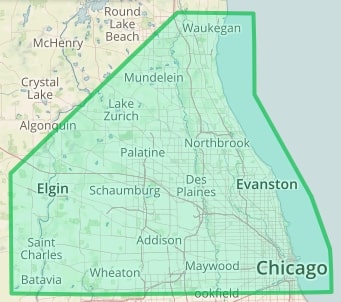
We also serve properties in these surrounding towns: