
Turf Fertilization & Broadleaf Weed Elimination in Arlington Heights
The grass really is Greener the way we treat it.
The grass really is Greener the way we treat it.
Drive down any residential block between Rand Road and Golf Road and you will notice the same pattern: lawns that were lush in May often fade to a patchy yellow-green by midsummer. The culprit is almost always the dense glacial-till clay that sits six to ten inches below the topsoil across the 60004 and 60005 zip codes. That clay layer traps moisture after spring rains and then hardens into a near-impermeable pan during July dry spells, starving grass roots of both water and oxygen.
Our seven-visit program was built around this exact challenge. We open the season with a split-application crabgrass barrier — half the active ingredient goes down in late March and the second half in mid-April — so the pre-emergent window stays active through the extended cool spring that northwest Cook County reliably delivers. Each subsequent visit pairs a slow-release granular feed with a liquid broadleaf spray, and we adjust the nitrogen-to-potassium ratio visit by visit as temperatures climb and fall.
What makes the biggest visible difference is how we handle the spray itself. Instead of blanket-spraying from a truck-mounted hose reel, our technicians walk every square foot of your yard with a backpack sprayer. That hand-application lets us vary product concentration between shaded side yards — where ground ivy and wild violet colonies tend to concentrate — and sunny front stretches where crabgrass and spurge are the bigger threat. The result is a far more precise treatment and significantly less chemical on the parts of your lawn that do not need it.
We pull up, unload the push spreader and backpack rig, and walk your entire property before applying anything. That initial lap lets us note wet spots, new weed pressure, thin areas from foot traffic, or damage from mole activity — all of which change how we calibrate the spreader gate and which herbicide nozzle we select. After treatment, we hang a detailed door tag listing everything we applied, any turf issues we spotted, and a recommendation for the weeks ahead (watering depth, mowing height, whether to hold off on irrigation if rain is forecast). If something pops up before our next scheduled visit, one phone call brings us back for a free re-spray.
"We moved into a house near Recreation Park with a yard full of Creeping Charlie. Two other companies told us the only fix was to tear it all out and re-sod. Greener Living treated it over three visits and the ground ivy is completely gone. Bluegrass filled in on its own by fall."
— M. & J. Kowalski, 60004
"Caymen actually walked our yard with us and pointed out drainage problems we didn't even know we had. After a season on the program our grass is thicker than it has been in the twelve years we've lived on Evergreen Avenue. Honest group of people."
— D. Patel, 60005
"Previous company used a ride-on and left tire tracks through my wet lawn every spring. Greener Living push-spreads everything on foot. No ruts, no compaction, and the results are night and day. My neighbors keep asking what changed."
— S. Lindgren, 60004
Beyond the 7-round fertilization plan, we handle every aspect of keeping an Arlington Heights yard healthy year-round:
Tell us about your yard — lot size, current condition, biggest headaches — and we will reply with an itemized estimate, usually within a couple of hours.
Caymen answers the phone, writes your program, and checks every property personally.
Illinois Department of Agriculture licensed, bonded, and carrying $2 M general liability.
Weeds return between visits? We come back and re-spray at zero additional cost.
Pay per visit — pause, skip, or cancel any time without a fee or penalty.
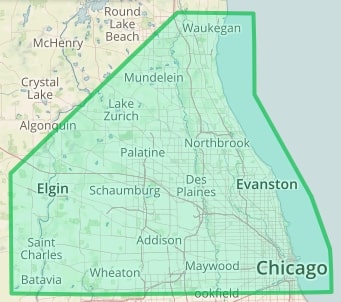
We are a small crew headquartered on the west side of Chicago that treats neighborhoods across the northwest suburbs every week. Our trucks roll through your property on Tuesdays and Wednesdays, so you will usually see the same two technicians all season. That consistency means they learn your property — the soggy corner near the downspout, the strip between the sidewalk and curb that dries out first, the shaded patch under the silver maple — and adjust product rates accordingly.
Local occupies a stretch of the Wheaton Morainal ridge left behind by the last glacial retreat roughly 14,000 years ago. The practical consequence for homeowners is a soil profile defined by dense, calcium-rich clay — excellent for retaining nutrients, poor for drainage and aeration. Walk across a newly thawed lawn in early April and you can often feel the spongy give underfoot where meltwater has nowhere to drain. By August, that same clay bakes into a hardpan that grass roots cannot penetrate past five or six inches. Each stage of our program accounts for this cycle: lighter, quicker-release nitrogen in spring when moisture is abundant, slow-release coated granules in summer when the top layer dries, and heavy potassium doses in fall to harden cell walls before the freeze.
Shade coverage is another defining feature. Older sections of the village — particularly the blocks between Eastman Street, Dunton Avenue, and the Metra tracks — are lined with white oaks, red oaks, and sugar maples planted sixty to eighty years ago. Those canopies filter most direct sunlight by late June, creating moisture-retentive microclimates where ground ivy and wild violets outcompete grass. Newer developments west of Arlington Heights Road tend toward full sun and different headaches: crabgrass encroachment, clover infestation, and heat-stress yellowing in July. Our technicians adapt the spray mix and spreader gate setting block by block rather than running a single recipe across every yard on the route.
The weed calendar in the area follows a predictable but relentless schedule. Crabgrass germinates once soil temperatures hold above 55 °F for four or five consecutive days — historically mid-to-late April in this area, though recent mild springs have pushed that date earlier. We counter it with a split-application barrier: the first half goes down in late March, the second in mid-April, extending the pre-emergent shield well into May. By early summer, broadleaf pressure shifts to dandelions, white clover, and plantain sunnier yards, while Creeping Charlie and wild violet colonies expand aggressively in shaded zones east of downtown. Our Momentum herbicide — a triclopyr blend — penetrates the waxy cuticle that gives ground ivy its notorious herbicide resistance. In late summer, yellow nutsedge occasionally appears in low-lying yards near Wing Park and along the Salt Creek corridor; we treat it with a sulfentrazone-based product that standard broadleaf sprays cannot touch.
September and October are the most productive months for building lasting turf density here. Warm soil and cooler air temperatures create ideal tiltering conditions for Kentucky bluegrass — the dominant species in most area yards. Our Round 6 application delivers a high-nitrogen feed that drives lateral shoot production, thickening the canopy before winter. Round 7, applied in late October or early November before the ground freezes, is a winterizer: a potassium-heavy blend that fortifies root reserves and improves freeze tolerance. Properties enrolled in aeration and overseeding will have been plugged in mid-September and seeded with an improved bluegrass-ryegrass blend bred at the University of Illinois turfgrass trials for disease resistance and rapid establishment. By the time the first hard frost arrives, new seedlings have typically developed two to three tillers and are rooted well enough to survive dormancy.
Many of the mature trees that define Arlington Heights streetscapes are showing stress. White-oak decline — characterized by thinning canopies and early leaf drop — has increased across Cook County over the past decade, partly driven by two-lined chestnut borer activity following drought years. Our deep-root feeding program delivers a balanced NPK solution below the dripline, supplementing what the tree cannot extract from compacted clay. We also apply dormant-oil sprays in March to suppress scale insects on ornamental crabapples and magnolias — two of the most commonly planted accent trees in local front yards. For evergreen hedges (arborvitae, boxwood, and yew are widespread here), we offer a fall anti-desiccant treatment that reduces winter burn caused by dry northwest winds.
Chicagoland sits within the Northwest Mosquito Abatement District, which manages standing-water breeding sites at the municipal level. Our role supplements theirs at the property level. We apply an organic cedar-and-peppermint barrier to shrubbery, fence lines, and shaded rest areas every three to four weeks from May through October. The plant-oil formula repels adult mosquitoes for 21 to 28 days without introducing synthetic pyrethroids into your yard ecosystem. For general pests — ants trailing along foundations, spiders in window wells, centipedes in basement stairwells — our perimeter barrier treatment creates a residual band around the exterior of your home that lasts approximately 90 days per application.
Get Your Custom Arlington Heights Quote → or call 224-415-3698
Our crews also treat properties in these nearby towns on the same weekly route: